
A LIGHT SHINING
IN THE DARKNESS

Introduction 2: PRE-Knowledge
Introduction 3: BOCCHORIS
Introduction 4: SESOSTRIS
Introduction 5: The Akhenaten Connection
The Original African Study Bible
Why THIS Guide Is Needed
How To Use This Study Guide
A Fixed Chronological Standard | Complying With 4 Laws Of Physics
The Science Of STL
My Theophoric Theory
Case In Point #1
Analyzing The Historical Records
A Man Called Jacob
A Fiction Called Joseph
Analogical Reasoning: Medjay & Hurrian
The Morphology Of Sinai & Shimishai
The HURRIAN Link | From Retenu To Sinai
Amenemhat III
The Execration Texts
The Execration Texts | Picture-Link
HYKSOS, Aamu & Shemu-Aamu (In Hieroglyphics)
LIBYAN, Puntite & AAMU
BECOMING Israel
RA The GOD | Ra The Man
EXAMPLE #1
Introduction
KNOWLEDGE IS POWER, especially when it's a manifestation of the truth. Therefore, TRUTH itself becomes a powerful weapon in the hands of those who know how to wield it. But this is equally evident in regards to a lie. For a lie is nothing more than a fabrication in the guise of a truth that imbues its author with a calculated degree of power. And POWER, as we know, is simply "the ability to cause change in conformity to one's will, while preventing one from changing against his/her own will" (almost precisely the same definition as MAGIC)! And it's sad to admit that in everyday, worldly reality circumstances often dictate that the lie is more expedient than the truth.
For example, when a parent warns an unruly child that Santa Claus won't stop at their house on Christmas unless the child behaves, the parent is exercising the power of fear. And almost every time it works just like magic (an alternative to physical force). But the warning only works on the child (when desirous of receiving Christmas presents) because of his/her ignorance of the truth: there's no such thing as a real Santa Claus! Yet many adult are there who entertain this very same kind of child mentality, whose entire lives involves an endless process of trading one Santa for another, being so easily manipulated by invented tales. And why? Simply because they haven't acquired sufficient, independent knowledge that would enable them to distinguish truth from falsehood on their own. Because they haven't learned how to read. Or, if they have, how to do so from more than one rigid point of view.
The most widely distributed book ever published is virtually free of charge. Yet the majority of the people who possess one have not taken the time to read it in its entirety for themselves. These people rely on preachers and their (the preacher's) interpretations of what is read to them. This book --- the most popular one in existence --- conceals truths that continue to elude the awareness of those who've been conditioned to comprehend it from one dogmatic and authoritative point of view. It is my intention to raise their level of awareness. To expose hidden truths. To put Santa to rest once and for all.
PRE-KNOWLEDGE
Elsewhere, I advanced the argument that a select, literate stratum of ancient Egyptian society were able to read certain material that required a specific degree of preknowledge to comprehend. I shall here provide a working example of that argument by analyzing the plague/pestilence-expulsion narratives attributed to Manetho, Lysimachus, and Diodorus Siculus. And I will do so under the presumption that the reader also possesses a preknowledge of the subject.
These stories, which the scholarly consensus recognize as a traumatic convolution of folklore, can be separated into their individual components and expanded upon. Before I begin deconstructing this collective memory, it's necessary to correct a partial mistranslation of the name Bocchoris, and return the true owner of this corrupted name to his proper timeframe: The 18th dynasty.
BOCCHORIS
This name should be correctly translated as Bak/(Boc "servant") + Ḥ/(Ch)-oris, i.e., "Horus". Servant (of) Horus. Which would be Horemheb, the pharaoh who succeeded Amenophis (Amenhotep III), according to the Abydos King List, from which Lysimachus' version of the events were most likely composed. On the other hand, the common populace remembered that Amenophis was followed by "a man altogether contemptible in his appearance". Which most certainly referred to Akhenaten, the son of Amenophis.
Like the legendary Bakenranef, Horemheb was also renowned as a wise reformer of the law. According to Diodorus Siculus (Library of History, Bk, 1, Part 2, Chapter 79): "Solon received a law from Egypt ... It had been made by Bocchoris and renewed by Sesostris.".
SESOSTRIS
This was the Greek rendering of a legendary figure combining the accomplishments of Senusret I - III, Sety I, and Ramses II (with Sesostris being frequently interchangeable with Sethos/Sety). While NO Sethoses are recorded in the 24th dynasty, several are noted from the 19th & 20th dynasties, with the first of them following almost immediately behind Horemheb.
With this PRE-knowledge, let's analyze the folklore from this restructured perspective: A religious upheaval, a pestilence, and an expulsion (which here becomes recasted as a 2-part drama centered on emancipation and subsequent conquest by divine sanction during the Amarna period).
The Akhenaten Connection
Akhenaten has shut down the temple estates of Amun. The slaves that once labored for the now despoiled King of The Gods are no longer his property. Though I have been unable to collect direct documentary evidence concerning the fate of these slaves, it is obliquely implied with a logical interpretation of Amos 9:7.
According to the LXX, the Lord had brought the Syrians from "the deep" (Grk bothros, meaning a "pit," "ditch," or "underground chasm"). In the Masoretic and KJV texts, "the deep" is substituted with "Kir" (an "enclosed" or "fortified" area). Through linguistic parallelism, the combined concepts give an idea of "a pit in an enclosed or fortified area".
A research paper submitted to Academia.edu by Ian P. Shears, confirms exactly how the word "pit" should be interpreted in the present context. Mr. Shears includes epigraphic evidence from Sinai (Inscription No. 117), which explicitly identifies the mining site at Serabit el-Khadim as "the great pit". Note that Serabit el-Khadim is located in Mizraim proper!
"His majesty Nimaatre (Amenemhet III) commands: 'Record this for Hathor, Lady of Turquoise: 300 sacks of pure stone brought from the great pit by overseer Sobekhotep...."
We know from other inscriptions that Ahmose I reopened the Sinai mines, and from additional inscriptions that both Thutmose III and Amenhotep II sent vast numbers of captives to labor there. Furthermore, we also find recorded for the first time in the reign of the latter, that 3600 Apiru/Hebrews were brought to Egypt as prisoners of war.
Would it be considered a stretch of imagination to envision these Apiru/Hebrews, along with the Syrians/Kharu, being liberated from forced labor at the mines, then becoming followers of the Aten? And the new, MOST-High God required one simple act of total devotion: The complete annihilation of rival gods (Deut. 7:1-2). With this PRE-Knowledge, we can absolutely place these events in the reign of Akhenaten, with corroboration being presented by the Apiru/Hebrew invasion of Canaan, and the overthrow of Jerusalem as described in the Amarna Tablets. It could also be quite possible that this particular segment of Egyptian history was intentionally erased along with the other visible, public traces of this vilified, rebel Pharaoh. But as soon as the traditional status quo was restored, we find Tutankhamen being exalted as the incarnation of Yah himself!
The Plague/Pestilence, however, happened during the time of Horemheb/Bocchoris, who was a contemporary of Suppiluliuma I, the Hittite king who died from this disease after Hittite soldiers unknowingly brought infected, Egyptian prisoners of war back to Hatti-Land.
Preface
This presentation is the product of 45-years+ of relentless research. Except for the initial guidance provided by my first true mentor, Doc, I'm unable to credit any relative, personal acquaintance, or licensed academic as a source of assistance. I am indebted, however, to those scholars who have written the books from which I accumulated the data that allowed me to abstract my own theories as a result.
LADIES FIRST: Carrol A.R. Andrews, Dr. Miriam Ayad, Margaret Benson, Lina Eckenstein, Joann Fletcher, Janet Gourlay, Dyan Hilton, Joan Lansberry, Dr. Margaret Murray, Stephane Rossini, Barbara C. Walker, Barbara Watterson, and that Muse adept at revealing secrets without really doing so: Dione Fortune.
Also to: John Baines, Darrell D. Baker, Robert Bauval, Samuel Birch, James Henry Breasted, Wallace A. Budge, Josias Bunsen, Peter A. Clayton, Aidan Dodson, Dr. Raymond O. Faulkner, Alan Gardiner, Dr. Ogden Goelet, Jr., Nicolas Grimal, J. Daniel Gunther, Graham Hancock, George Hart, Christian Karl, Jaromir Malek, Bill Manley, Gaston Maspero, Bill Petty, Samuel Philo, David P. Silverman, James Wasserman, and Toby A. H. Wilkenson.
And of course: WIKIPEDIA
The theory that developed, due to the contributions of the afore-mentioned authors, is already being vehemently criticized by the academic consensus. But, as I've already stated, I dare any one of them to challenge me in a televised public debate.
Prologue
I advance the theory that the Biblical Moses is a fiction based upon the biographies of actual historical people. From what I can gather, the scholarly consensus hasn't heard anything this radical before. But, truth be told, there's really nothing novel about my theory, because a precedence for it is exemplified in the legendary exploits of the Egyptian king Sesostris. The difference is that Sesostris was a real person, whose military campaigns were conflated with those of Seti I and Ramses II. The Biblical Moses, however, without the framework of 18th dynasty Egypt, is a lifeless chimera. So, throughout this presentation, even though I refer to the Biblical Moses as if he was an actual living entity, I do so only for the sake of providing narrative. Because, not only do I completely deny the existence of Moses, I also do not believe that the Old Testament was originally authored by the ancient Jews. I maintain that the Jews translated secondary Egyptian texts, via the Alexandrian Greeks, into Hebrew, and not the other way around. Lastly, I put forth that the Old Testament timeline conflicts with verified ancient Egyptian history and, consequently, negates the biblical narrative concerning Joseph, the bondage of a people called Israel, the deliverance by Moses, and the conquest of a promised land. Jadeists regard this genre of literature as Historical Myth. This, too, I shall demonstrate with firm textual evidence.
Fiction
According to Wikipedia, fiction is any creative narrative in writing, film, or other medium, that portrays imaginary people, events, or places. Rather than being based strictly on historical facts or reality, it stems from the author's imagination. it serves to entertain, explore human experiences, and convey deeper truths.
Historical Fiction
According to Wikipedia, historical fiction is a literary and narrative genre where the plot takes place in a recognizable past setting, blending factual historical events with imaginative storytelling. It generally features a mix of completely fictional characters and real historical figures, requiring extensive research into the era's customs, dialogue, and social norms.
The Original
African Study Bible
The Original African Heritage Study Bible (edited by the late Dr. Cain Hope Felder, the renowned biblical scholar) simply highlighted the biblical figures of African descent. I intend to proceed from where the illustrious Dr. left off, amplifying the great work by providing actual, historical images of the kings whose biographies contributed to the persona of the biblical Moses, and demonstrate that Moses was a fictional composite based upon the religious and military exploits of BLACK historical prototypes!
The present essays follow the Jadeistic framework. Its immediate purpose is to demonstrate the proper use of my Bible Study Guide. The Biblical Moses remains viewed through the lens of Historical Fiction, and still a composite of Egyptian royalty bearing distinct lunar theophorics. The pivotal figure of this study, and who will also serve as a chronological anchor, is Ahmose I, whom I have designated as Moses III (M3).
Why THIS Guide
Is Needed
There are 3 standard versions of the Bible: The LXX, Masoretic, and AKJV. They all differ in how they compute the chronology of events. In an ideal scenario, only 1 of them can be right. However, in this practical world of reality, I regret to say that neither of the O.T. books are correct --- without you!
For, though it isn't immediately apparent, Black history is being recorded in the exact timeframe as those events in the O.T., but is overshadowed by the Biblio-centric narrative. So this study guide is designed to help you learn how to analyze O.T. history in order to discern, separate, and place the relevant narratives in their proper chronological sequence. And, by so doing, to eventually allow you to strip away the pseudo-historical veneer that conceals your ancient existence.
What do I mean by Biblical history? I mean the events that the Bible says occurred (in the O.T. tradition) between the creation of this world in c. 5500 BC until Point Zero (the dividing line between BC and AD).
Because, if like many people you find it necessary to embrace a religious faith, from a purely philosophical and logical point of view, a faith based on truth is considered superior to one based on lies. Ultimately, this guide should help you establish a faith built upon structural integrity and that provides long-term viability.
This guide, therefore, results from the need of a new Histo-Biblical Paradigm.
How To Use
This Study Guide
This guide is meant to be used in conjunction with the following Bible versions: LXX; Masoretic; & KJV.
While doing so, remember:
1. The Bible narrative doesn't transpire in a vacuum. Though it gives infrequent mention of nations other than Israel, they do exist side by side. So the first thing you should do is determine the date in which the narrative is set.
2. Get an idea of the contemporary events. Particularly those of Egypt.
3. Determine if the narrative could have happened exactly as it claims at that time and place.
4. Search for evidence of the things described in the narrative in conventional historical sources. You must reserve room for the possibility of Academic/Scholastic Bias, wherein the extrabiblical documentation is unacknowledged because of linguistic discrepancies (e.g., 'Apiru vs. Hebrew).
5. If they cannot be substantiated, determine what genre of literature the narrative really represents.
A Fixed
Chronological Standard
We adhere to a fixed, standard measurement of the Egyptian timeline as set by the consensus of academic chronologists, and under no circumstances attempt to modify this system in order to put Egyptian history in alignment with the biblical narrative. We can calculate no honest, scientific advantage of altering facts to conform to non-facts. Our timeframe of reference will be Egypt's New Kingdom, traditionally computed to c. 1550 BC - 1070 BC. It is within this interval of time that the biblical Exodus, conquest of Canaan, and period of the Judges supposedly took place. While applying the principles of Historical Science to this period, we will acknowledge 4 fundamental laws of physics: (1) No 2 separate events can occur in the same space at the same time. But if this appears to be the case, we know that they are really the same event viewed from 2 different perspectives by 2 different names. (2) No singular event can be and not be at the same time; (3) For causally linked events, the cause must precede the effect; and (4) No singular event can happen in 1 particular place at 2 different times [e.g., the conquest of Sharuhen by Ahmose I (c. 1550 BC), then the conquest of the same (destroyed?) city by Joshua more than 150 years later (yet, according to the Book Of The Wars Of The Lord, the same city was still standing, and revolting against Egypt)! As was the similar case with Jericho which, according to archaeology, was also destroyed c. 1550. Or the BEST example of all: The Hittite Cavalry Scene!]. By these 4 laws we will compare the Egyptian and biblical narratives against each other to determine which were possible, impossible, or highly probable.
In either case, the Black Historical Version receives priority over the biblical account. The reason being is, that which is actually written down tends to preserve more accuracy than that which is passed down solely by word of mouth (oral tradition). Because, until the Hebrew slaves finally developed an alphabet system and became proficient in writing and reading it, they were illiterate.
The Science Of
Squaring The Light
This deliberate effort to separate truth from un-truth is the definition of science:
< Lat. scientia "knowledge" or "awareness". To Lat. verb scire ("to know"), linguistically to PIE roots "to cut" or "to separate", implying a process of discerning or splitting facts from fiction. The original notion in the Lat. verb is "to separate 1 thing from another, to distinguish," or else to "incise". This is related to scindere "to cut, divide" (from PIE root *skei- "to cut, split," source also of Grk skhizein "to split, rend, cleave," Gothic skeidan, O.E. sceadan "to divide, separate").
What is this but Dividing The Word (WḏꜤ-mdw)! What is this but SQUARING THE LIGHT!
To "square" something means to reconcile inconsistencies, ensuring 2/more ideas, facts, or actions align so they are logical, consistent, and coherent. It comes from Geometry, where squaring corners creates a true, balanced structure. And are not Egyptian history and the O.T. narrative contradictory in many aspects? My Theophoric Theory resolves most of these contradictions.

My Theophoric Theory
My Theophoric Theory has been labeled (sometimes unjustly & inappropriately) as a "Fringe," "Revisionist," and/or "Speculative" Framework. And while I diligently applied the Scientific Method every step of the way, I couldn't understand why my critics failed to do the same. Bearing in mind that absolutely no artifacts were uncovered that directly proved the existence of Moses, upon what exactly is it that scholars base their argument for his existence? It's based upon the biblical narrative itself! My arguments, however, are based upon physical [biblically-] contemporaneous artifacts. My resulting hypotheses were precipitated by unsettling observations, and the need to answer the questions:
Why do these so-called main-stream scholars persist in asserting the existence of people who can't be mathematically located on the timelines to which they have been variously ascribed? And why is such unprofessional conduct even tolerated by 'whomever' are vested with the authority to check it?
Chronology
Chronology is supposed to be a science of measuring time, determining the true dates of past events, and arranging them in their correct sequential order. It's supposed to ENSURE that occurrences are placed within a proper VERIFIED timeline. What's more --- and what these mainstream scholars appear to ignore --- is that specific aspects of chronology are directly governed and correlated by fundamental laws of physics (stated above) which dictate what sequence of events are possible, impossible, or merely probable, ensuring that the universe operates in a logical, non-contradictory manner (or as we say, "according to Ma'at").
Thus far, most of the consensuses on the historicity of the O.T. narrative have reflected a blatant disregard for these laws.
Case In Point #1
[Case in point: When Josephus cited Manetho, then explicitly identified the Hyksos as the "Ancestors" of the Israelites, this identification became the 'consensus' --- even though Manetho's account was in sharp contrast to EVERY Biblical narrative of the bondage and subsequent exodus of Israel! And it REMAINED a consensus for approximately 1,800 years! Until the tomb of Admiral Ahmose, Son of Ebana, was discovered and the 'contradictions' were afterwards too publicized to deny. My hypothesis was supported by the biography of Ahmose, Son of Ebana). But why did it have to take the academic community that long to realize they had made an error? Because certain people just couldn't accept the possibility that the Bible story was a myth? That's a rabid kind of desperation, extending far beyond the point of patheticism. Yet, even after the tomb of Ahmose, Son of Ebana, was deciphered, those so-called scholars STILL failed to make a cognitive connection between the CONTEXTUAL similarity of the 2 narratives: Both containing an emphasis on the names "Yah" and "Mose(s)"!
All they had to do was apply the rules of chronology and determine if the resulting series of events possessed logical contiguity:
A Man Called Jacob
(1) A man called Jacob is renamed Israel. [NOTE: The first 'coincident' (or highly probable Empirical Nexus) is the attestation of a S.I.P. King by the name of Yakub-Har]. (2) He sought after God at Bethel (Gen. 28:10); or he found him in "The house of On" (Hosea 12:4 LXX). (3) His son, Joseph, is thrown into a pit by jealous brothers. He's eventually pulled from the pit by Midianites (Gen. 37:28) who sold him for 20 pieces of silver to Ishmaelites, who in turn transport him by camel to Egypt, where he is sold to Potiphar. (4) A Hebrew clan of 70 souls seek refuge in Egypt during a famine (Gen. 46:27; Ex. 1:5. From the expulsion of the Hyksos to the arrival of the 3600 Hebrew prisoners of war, is approximately 4/5 generations. "But in the 4th generation they shall come hither again; for the iniquity of the Amorites is not yet full." (Gen. 15:16)). [NOTE: The second 'coincident' (or highly probable Empirical Nexus) is a contemporary inscription describing the "taking of 70 prisoners to the stronghold of Amun". Amun's stronghold was located in Thebes, which is also known as the Southern On. And Amenhotep II was its God & Ruler!
At first glance, can you make sense of the above? Is it any wonder that there has been a shift in scholarly consensus concerning the historicity of Moses and the exodus? However, the main issue has yet to be completely resolved: the origin of the Moses character. Now modern scholarship generally views the Moses narrative as a "theologized history" rather than a strict, journalistic record. And they continue to treat the exodus as a foundational cultural memory --- perhaps involving a much smaller group of people ( a proto-Israelite or Levite tribe) leaving Egypt under the guidance of a charismatic leader --- which was later expanded upon to unify the broader nation of Israel. So who was this charismatic leader, and when did he live? The Bible scholars are no closer to answering these questions. My Theophoric Theory offers the most plausible solution.
A Fiction Called Joseph
Clearly, the Joseph story is a complete fiction,* contrived only as a transitional episode to explain how characters got from Point A (the "Yakub-Har" story) to Point B (the "Bondage" story) --- which was actually a "Prisoners of War" story; then to Point C (an Exodus) that was contemporaneous with the Amarna Period --- which I intend to prove].
* This conclusion is backed by empirical evidence as a result of scientific investigation. (1) Archaeology confirms that the domestication of camels as human-transport animals hadn't occurred yet (Gen. 37:25 KJV), (2) The horse-drawn chariot hadn't been introduced to Egypt yet (Gen. 41:43), (3) No single ruler of both Upper & Lower Egypt at that time (Gen. 41:41); and most telling of all, (4) Imprecise math: the discrepancy between chronological & biological time. Jacob supposedly enters Egypt at least 9 years after the birth of Joseph's sons (Gen. 45:6), then dies 17 years later (Gen. 47:28). Yet, incredibly, the two siblings have remained "lads" long enough to still be able to stand between Joseph's knees (Gen. 48:12). Neither a historical Joseph nor his miracle lads could have existed during the time in question. No rational person would dare promote this as truth! However, the internal errors were never corrected. They must have been allowed to remain for a specific reason.
TO BE CONTINUED ....
Divine Lineage Of Moses
I will begin by first highlighting that common denominator which not only established a theological link between the historical prototypes, but also attested to their connection to, and worship of, a Black God --- Min (and by extension Osiris). Whether or not Min's color signifies a racial identifier, or is strictly symbolical, is a speculation that will not be elaborated upon at this time. However, I direct your attention to the skin colors used to depict the king & queen below (Ahmose I & Ahmose Nefertari were siblings), yet submit that the worship of a black-pigmented god could be purely coincidental. The point being made is that the New Kingdom period begins with a BLACK dynasty, and its 1st king served as one of the inspirations for the biblical Moses.
His complete titulary was:


We are challenged here with the first of many conflicting narratives. I'm referencing the LXX, since it contains the earliest date for the birth of Moses (c. 1520 BC). As the math plainly shows, not only was Ahmose I already familiar with the god of the biblical Moses, but so was his mother Ahhotep (as was the case with Jochebed, the mother of the biblical Moses).

With the evidence already set before us, how are we to interpret Exodus 6:3? That Moses --- if a real person --- is only the first among the Hebrews/Israelites to know the name of this god? Not even Abraham knew it. But the Egyptians already knew of it. So was it originally an Egyptian god --- even though he supposedly encountered it on Mt. Sinai? We know that the Sinai Peninsula was controlled by the pharaohs as early as the 1st Dynasty (c. 3100 BC), and several Egyptian deities were worshipped there.
Let us establish the identity of pharaoh during the time of Moses' birth, as per LXX reckoning. That would've been Thutmose I.
TO BE CONTINUED ....

Now I ask that you consider these facts: (1) Paheri recorded the war stories of his grandfather, Ahmose Son of Ebana. Because of his grandfather's extraordinary military service, their family was not only honored by being appointed to high administrative offices, but Paheri was given the privilege of becoming the royal tutor to 2 sons of Thutmose I: Prince Amenmose (the eldest son & heir) and Prince Wadjmose. Imagine the stories the princes heard while perched upon the knees of Paheri. All of them involving the heroic deeds of men whose names contained "Mose(s)". I would even venture to say that Paheri was probably the primary disseminator of those sagas that eventually ended up in the biblical narrative, trending first within royal court circles.
TO BE CONTINUED ....
TRANSMITTING HISTORY
WHAT WAS PAHERY?
Is he an indigenous Egyptian? If not, by how many generations can his family claim nativity? What is the meaning of his name? We are given 2 main ones: "the celestial one," and "the chief". But surely the second one is more of a title than a birth-name. Its orthography is very similar to the root structure of name Phinehas (Pa-nehes, which meant "the Cushite/Ethiopian"). Could his name also be an indicator of his ethnicity? We already know, for example, that "Jewishness" is determined by the mother's blood. And, likewise, the ancient Egyptians in matters pertaining to divine succession, inheritance, and spirituality, expressed greater deference for a matrilineal tradition. Pahery certainly did so, for he places greater emphasis on his mother than his father when tracing his biological roots. He is the son of his mother, Kemi ("The Black One")! I would say that, from this, we can safely establish the fact that Pahery considered himself as being descended from the "Black" one. As Wikipedia has shown, Pahery's name also bears a striking resemblance to that of Bay the Syrian/Horite:


Analogical Reasoning:
Medjay & Hurrian
Time for some Analogical Reasoning. As you know, the Medjay were initially Cushites who patrolled the east desert and protected Egypt's borders in the Sinai regions. At the beginning, these border guards were composed of Cushites exclusively --- all of them from the Medjay tribes. But, as time went by, Medjay became synonymous with "PROTECTION", regardless of the racial characteristics of the person providing it. When it was in reference to the Medjay only, the technical term was Ethnic Eponym. Just as Ta-Seti was called "Land Of The Bow" even though that's not the true meaning of the name. But it was called Land Of The Bow because the best archers came from there. In The kingdom of Mitanni, the Hurrians formed the dominant(?), ethnic majority --- which means they were the most educated(?) and organized, and the best(?) qualified to administer politics [we are given a glimpse of their ability when Moses's father-in-law advises him on the best way to lead a large mass of people (Ex. 18:13-27)]. As such, the Egyptians used the Hurrians for the labor they were best suited for: technical knowledge and controlling the masses. I submit to you that the Egyptian word "chief" became an idiom for Hurrian. I admit, it's a speculation based upon indirect evidence at this point, but well grounded.
When Egypt entered its New Kingdom phase, the lingua franca of Canaan was Akkadian. We know this without doubt, because all major business and political correspondences were recorded in Akkadian cuneiform (e.g., those between Canaan "chieftains" and Amarna, Egypt; and the chief in charge of Jerusalem had a Hurrian name: Abdi-Heba. He owed his position to the graces of Pharaoh). Next, consider the fact that the biblical Moses has the encounter with god on Mt. Sinai. I agree with the academic consensus that Sinai is of neither Hebrew or Egyptian origin. It's Akkadian. And their moon-god, Sin,* is the counterpart of Egyptian Iah. Which means that at some point, the Akkadians also had a hand in composing the Mosaic Narrative. Besides the Mt. Sinai input, they also contributed 2 others: The " Moses-drawn-from-the-water" theme, which mimicked the rescue of Sargon The Great from the Euphrates River; and the word "Mizraim", which became the designation for the land of Egypt itself.
The Morphology Of
Sinai & Shimishai
* Consider the morphology of SinAI & ShimishAI (Ezra 4:8). In the latter, the meaning is "sunny," or that which "pertains/belongs to Shemesh" (the sun god). In Mesopotamian mythology, Sin is the father of Shemesh. We may safely infer that the correct meaning of SinAi is "moony", or that which "pertains/belongs to Sin" (the moon god). Is it mere coincidence that, before migrating to Canaan, the biblical Abraham dwelled in Haran, a city heavily populated by Hurrians, and where the main deity was Sin (also known as Nanna)? From this correlation we have the historical evidence necessary to equate the Biblical Yahweh with the Egyptian Iah. Variant spellings for the same god!
WHAT'S AN AKKADIAN?
Anyone who was a part of Sargon The Great's empire, which had its capital in the Mesopotamian state of Akkad. It encompassed a multitude of independent city states, with Sargon being the first in recorded history to unite these diverse nationalities on such an extensive scale. Let's draw another analogy: America. What's an American? What does one look like? Such was the Akkadian. Mitanni was an offshoot of this Akkadian empire, itself being comprised of various nationalities, of which the Hurrians constituted the majority, and possessing its own unique ethnicity.
If we can isolate the human links resulting in this exhibition of Egypto-Akkadian Syncretism, we can attain a revealing retrospective into the evolution of the Mosaic Narrative.
TO BE CONTINUED ....
THE HURRIAN LINK
- From Retenu To Sinai -
According to the current consensus, the Hurrians don't enter the Levant en masse until the late 17th century BC. Based upon the evidence, I concur. But there is also other evidence which proves that, before the greater incursion of the Hurrians into Canaan, individual Hurrians were already interacting with Amenemhat III (d. c.1814 BC), of the 12th Dynasty.

SINAI INSCRIPTIONS
An inscription inside a temple of Hathor, at Serabit el-Khadim in the Sinai peninsula, recounts how a company of 10 men from Retenu led by a man named Khebded assisted in Amenemhat's mining operations.
My research reveals that: (1) the root of the name (Khebded) revolves around the consonants Kh-b (or H-b), (2) In Hurrian and Hittite traditions, names frequently received a suffix ending, such as -t (as in Khebat or Khebedet) or -a (as in Kheba), and (3) In ancient writing systems --- like cuneiform --- the consonants 'B' and 'P' often represent the same phonetic sound or were frequently interchangeable in regional dialects (such as Ugarit and Syrian).
As to the historical context of the names, Khepat, Khebat, and Kheba all refer to alternate spellings for the Hurrian goddess Hebat. And Khebedet is a variant of that name as it evolved through regional dialects across the ancient Levant and Anatolia (modern day Turkey).
Finally, I draw your attention to Genesis 36:22 "The children of Lotan were Hori and Hemam; and Lotan's sister was Timna.".
From Hori is derived the Horites, which are equated with the historical Hurrians!
Recalling the transliteration of the Egyptian 'R' into the Greek 'L', coupled with the fact that vowels are arbitrary, Rtn(w) [or Reten(w)] becomes Ltn(w) [or Lotan(w)]. Thus, the earliest attestation of the word Retenu (or Lotan), in reference to a land in the Levant, occurs in the Tale of Sinuhe, a work composed during Egypt's 12th Dynasty!
TO BE CONTINNUED ....
THE EXECRATION TEXTS
The scholars would like to challenge me on the premises set forth in the previous section but, alas, to do so would entail repudiating their own authority. For the almighty consensus has assured us that the Execration Texts are attributed to the 12th Dynasty, and in these texts references to the chiefs of Seir are clearly attested.
TO BE CONTINUED ....

Yaqub-Har As Jacob
BEGINNING with Yaqub-Har (or is it really -HOR?)
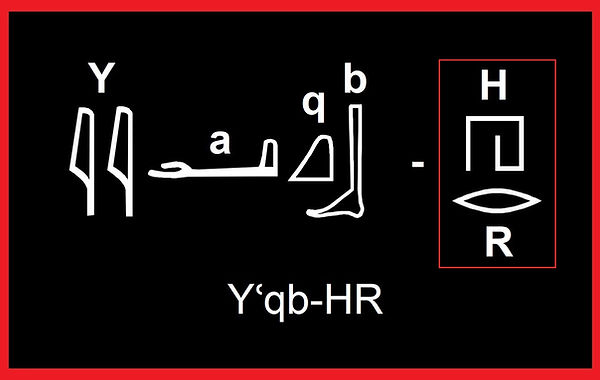
We (the Jadeists) consider this foreign ruler to be the model for the biblical Jacob. Hyksos was the name given to the foreign rulers of Egypt, particularly in the delta region. It is a diminutive of the compound term: Heqa (ruler) & khasut (hill/foreign land/country). From the interpretation of official Egyptian records, it is concluded that the foreign rulers were placed in at least 2 categories: those who honored the Egyptian gods, and those who didn't. According to Hatshepsut, the hyksos were specifically known to the native Egyptians as Aamu or Shema Aamu. As far as my research reveals, the name doesn't designate a distinct ethnicity, but rather a culture that seemed prevalent to the region North-East of the Delta. The earliest depiction of them occurs during the reign of Sahure. Over the years, the facial characteristics of the Aamu exhibit different features.


By officially acknowledging the god Ra, he became a follower or man of Ra. Now, consider the following Analogical Reasoning: If (biblically) a 'Man of Baal' is rendered Is(h)-Baal, then that of a 'Man of Ra' will be Is(h)-Ra! In the context of Egyptian onomastics, it would have been expressed as Ra-i/y (as a 'Man of Set' becomes a Set-i/y). In the case of the latter, an indication as to the nature of that which 'was followed' would be given. Was it 'ra' (the physical sun), or 'Ra' (the god/El)?*

* I am here acknowledging the convention of Honorific Transposition. Now, consider the admonishment, "If my people, which are called by my name ...." (2 Chr. 7:14). Is the allusion to descendants of an eponymous ancestor who worshipped Ra, or to a culturally diverse people who worshipped Iah? These are 2 different gods. Therefore, we would be justified in the assumption that both gods were worshipped simultaneously. Could this have been so even during the Amarna Period?
TO BE CONTINUED ....