
A LIGHT SHINING
IN THE DARKNESS
Moses' Ethiopian Wife
- Versus Aaron & Miriam -
UPDATED AUG. 10, 2026 4:55 A.M.
TABLE OF CONTENTS
SIBLING Rivalry
GOD'S WIFE Of Amun
WHO Are Aaron & Miriam?
THUTMOSE IV (Moses 7) | Atenism & The Midian Wife
IARET (Pic)
IARET (Name)
MOSES' Brother | The Spokesman
THUTMOSE IV's Brother
AARON (In Hieroglyphics)
AARON (As A Title)
THUTMOSE IV (Moses 7) | A God & Prophet Of Dreams
3 MOSESES Unveiled
WRITING On The Walls | State Secrets
NOTE 1
SIBLING RIVALRY
After reading Nu 12:1, we are left with wonder concerning the animus of Moses' siblings toward his Ethiopian wife. Are their feelings motivated by racial conflict, or is there a more evasive reason? The second verse appears incongruent to the first: "...And they said, Hath the LORD indeed spoken only by Moses? Hath he not spoken also by us?...."
The cue verse is when the LORD responds, "Hear now my words: If there be a prophet among you, I the LORD will make myself known unto him in a vision, and I WILL SPEAK UNTO HIM IN A DREAM.". The operative word being Prophet (v.6). What does prophecy have to do with Moses' choice of this Ethiopian for a wife? What will his siblings stand to lose because of this choice? This is a juncture in which the Biblical Narrative needs be supplemented with actual Egyptian history. Be reminded that the Biblical Moses is a composite of real historically recorded people (King's Theophoric Theory), and what appears to be the action of a single individual can, in reality, be the cumulative deeds of many, presented in a convolution of disparate narratives. Thus, in the context of the above passages, the conflict --- if there had actually been one --- would not be racially centered, but more a matter of vying for religious status.
GOD'S WIFE OF AMUN
Ahmose I--- who is here Moses 3 (M3) --- 1st king of the 18th Dynasty, inaugurated a radical political policy. For his Ethiopian sister-wife, Ahmose Nefertari, he created a new religious office --- God's Wife Of Amun. Up until then, the roles of First and Second Prophet of Amun were appointed to males only. Thus, the Ethiopian wife was going to cause a break in convention, becoming the first Prophetess Of Amun in a High Priestess capacity.
WHO ARE AARON & MIRIAM?
The question now needs be asked: Did King Ahmose have a sister named Miriam? Because no serious student of the Bible & Egyptology would fail to notice the similarity between that name and Mer[i]-Am[un] ("Beloved Of Amun"). He didn't, but his daughter bore that name. Nor did he have a brother named, or with a name similar to, Aaron. Thutmose IV, however, did have a brother and sister who, to a dramatic extent, resembled that of the biblical portrait. Yet, in this instance, the issue is purely academic, since it can be proved that the Ethiopian and the so-called Midianite are two different women.
THUTMOSE IV (Moses 7)
- ATENISM & The Midian Wife -
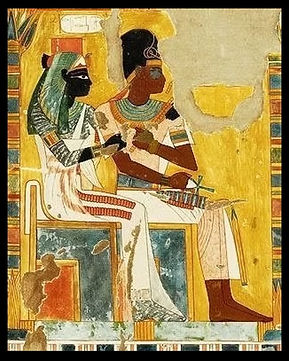
Thutmose IV, as you recall, married the Midian/Mitanni princess. (Proving Midian is Mitanni). What most people aren't usually aware of is that it was he who introduced the concept of Atenism, making him that Moses responsible for the start of monotheism. Of his siblings, 2 stand out: sister-wife Iaret and brother Ahmose, of whom no pictures are currently available.
Below: Iaret at far left.
IARET (At Far Left)

IARET (Name)
Iaret's name included the determinative of a cobra which, besides denoting "Goddess" in general, was a symbol also peculiar to Hathor the moon goddess of love, childbirth, and astrology, suggesting that Iaret might've been one of her priestesses. Under these unusual circumstances, it's not hard to imagine a real-life conflict between rivalling spouses: Moses' native sister-wife antagonizing his foreign Mitanni wife. (See NOTE 1).
MOSES' BROTHER
- The Spokesman -
The Bible makes Moses' brother his spokesman and prophet: "And the LORD spoke unto Moses, saying, Behold, I have made thee a god to pharao, and Aaron thy brother shall be your prophet, and thou shalt say to him all the things that I charge thee, and Aaron thy brother shall speak to pharao...." (Ex 7:1-2).
THUTMOSE IV's BROTHER
Thutmose IV's brother was indeed a prophet, holding the post of High Priest Of Ra in Heliopolis. If you were to look up the meaning of Aaron's name according to Bible-related sources, you'll inevitably arrive at "Exalted," "Mountain Of Strength," or "Great Light", the last one being the only to bear a semblance of accuracy. On the other hand, if the biblical rendering of his name is used in concordance with its Egyptian counterpart (Aaron is a completely Egyptian name!), the definition becomes more precise.
Based upon A. Gardiner's Sign List:
AARON (In Hieroglyphics)

AARON (As A Title)
We see that Aaron --- which is properly designated a "title" rather than a personal name --- from the original Egyptian etymology, becomes comprehensible as "Great/Chief Mouth/Spokesman (which the Bible equated with prophet) of On" (the original Egyptian name for Heliopolis. Gen 41:45 AKJV; Ex 1:11 LXX. Another reason why I advocate use of the LXX is, because apart from being the OT prototype, it's the version used by the first Christians. You need only compare Ex 12:40 AKJV with the same in the LXX, along with Galatians 3:17 AKJV, and you will instantly see the proof of it).
THUTMOSE IV (Moses 7)
- Prophet Of Dreams -
And this Moses did end up being worshipped. His "Cult Of The God", at his mortuary temple in Thebes, remained active more than a century after his death! It centered on his Dream Stele. Thus he becomes a prophet of Iah who communicates with the god through dreams. This presents that juncture in Egyptian history when Iah & Aten probably first began to merge.
3 MOSESES UNVEILED
So far, I've brought to your attention the existence of 3 Moseses. Yet there remains at least 4 more. Also, thus far, I've made it a principle of academic obligation to present you with nothing but verifiable facts. But how you interpret them is your prerogative. Rest assured, though, that no one can truly form realistic opinions, or devise rationally-based solutions without first becoming aware of the facts.
WRITING ON THE WALLS
Most serious Bible students take for granted that capital-offense crimes were committed for the privilege of having certain literature at their disposal. For western religion ultimately traces its roots to ancient Egypt, and the primary corpus of their religious writings were inscribed inside pyramids --- sacred tombs. And the "Writing On The Walls" was reserved for Pharaoh's Eyes ONLY! (with the exception of the artisans who chiseled them, though they might not necessarily have known their meaning or significance). In the parlance of modern day society, the Pyramid Texts are nothing less than Classified State Secrets, requiring the highest levels of clearance to access. So when you read your Bible, never lose sight of the fact that you're also delving into political secrets unawares. Even at this very moment --- if you're not a Black Initiate --- you are learning secrets that were never meant for your eyes.
NOTE 1
AI has misconstrued this narration to make God's Wife of Amun contemporaneous with the High Priestess of Hathor. Simplifying an explanation to the uninitiated, as to why this is not so, is a dilemma I currently lack the patience to address. Instead, I would redirect you to an explanation, or return you to the current section.
TO BE CONTINUED ....